Author Archives: Harinath

What is Twitter for me?

Twitter, has been a much acclaimed tool for most of us today. Professionals, Technology Enthusiasts, Media, Famous Personalities, Actors, Politicians etc are all getting on to twitter to make their Social Presense felt across.

I joined the Twitter Bandwagon around one and half years back and since then, it has become one of my everyday addictions. I use twitter to keep in touch with my friends, know what my clients are doing and learn new things which spread like wildfire in News and Technology.

I keep twittering, but only dedicate around an hour every day (30 minutes in the morning and 30 minutes before I go to bed) to read through all tweets posted by whom I am following. If there is any interesting read, I favorite the tweet and re-visit when I get more time. I do not want my timeline to be cluttered with any unnecessary information and hence I protect my tweets and ensure I cross check if anyone requests to follow me.

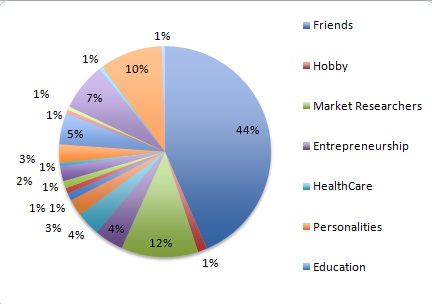
Here is a synopsis of whom I follow:

44% of whom I follow are my friends. In this category, I include people who have requested to follow me or I request to follow even though we do not know each other personally and it is just mutual interests which bring us together.

I work in the HealthCare domain, and my clients are Hospitals and Clinics. (Most of the Hospitals I follow are my clients)

@harinathpv Twitter Statistics

@harinathpv Twitter Statistics

10% of whom I follow share the same hobby with me (Photography, Technology, Gadgets, Innovation etc).

12% of whom I follow are into Market Research across the world.

Remaining are interesting personalities from whom I can learn one thing or the other.

Its a long way to go, but am on my way of using Twitter to keep my passion going and learning…..

Sony PRS 700 Vs Amazon Kindle

Well .. Well, I might not have extensive technical research on the two e-book readers in the market, but have done a decent study. Off late, I am getting more passionate to buy one of them as I can save space at home. Today, its fine, but when I think of life ahead, I will need to move to electronic book reader, rather than keep buying books and fill the house…

Currently, there are only two e-book readers available- Sony PRS 700 and Amazon Kindle (as I know, and if you know more, please let me know) and both of them have their own monopoly. Binding their customers to themselves and not providing much of flexibility. Also, I tried quite a few online book stores, and no one sells e-books 🙁 What if i just want to buy an e-book and read it on my laptop? Unfortunately, no one can help me with this.

I live in India and so, my options are much narrow. Well, for ease of supporting my current decision, look at the table below.

Features Kindle Dx Sony PRS-700
Display 9.7″ 6″
TouchScreen Yes Yes
Built in Reading Light Yes Yes
Search Yes Yes
Annotations Yes Yes
Highlight No Yes
Text Adjust Yes Yes
e-Book Stall? Yes Yes
Formats Supported Kindle (AZW), PDF, TXT, Audible (formats 4, Audible Enhanced (AAX)), MP3, unprotected MOBI, PRC natively; HTML, DOC, RTF, JPEG, GIF, PNG, BMP PDF, Doc, BBeB, Txt
Battery Life (Single Charge) 2 Weeks 2 Weeks
Wireless Yes No
Horizontal View Yes Yes
Expand Memory? No Yes
Inbuilt Capacity 3,500 Books (4 GB) 350 Books
Read-to-me Yes No
Audio 3.5mm Jack No
Built in Dictionary Yes Yes
Music and Podcast Yes No
Sold in India No No
     
     
Price $489.00 $349.99
INR Rs.23,299.94 Rs.16,676.37

The above prices are on the day I compiled this post (not posted).

Guess what I have closed in as of now? None other than the PRS700. Why? It is simple, even though Kindle provides more flexibility, there is no point in buying it because Amazon does not allow me to buy a book, download into my Amazon account and then transfer to the reader. I can order on the web, but the book will be directly delivered to the reader through the wireless and for this you need to be only in US. There is no point in discussing this gadget anymore.

Coming to PRS 700, this is not sold in India (also I checked with Sony India if they can bring it for me, but they bluntly refused). Here is the list of key differentiators as to why you need to buy PRS 700 if you in India…

  1. Sony e-Book store delivers to your account and you can transfer the book to your device through USB.
  2. You can also transfer PDF files easily.

After posting this post, I stumbbled upon few interesting links for e-Book readers, do check them out…

e-Book Reader Matrix, Hardware e-Book Readers, Where to Buy

World of Ideas…

I was recently reading an interview of Mr. Narayana Murty on Rediff and decided to write this post. Mr. Murthy, in his interview touches upon few key aspects of today’s living – Education (Why half of India’s Engineering Graduates are not getting employed) and Politics. In one line, I 100% agree to what Mr. Murty is saying about Politics and Government – That the Government should concentrate on providing basic education, primary healthcare and create a conducive environment for living and the remaining would fall in place as and when required.

The aspects I would want to touch upon a bit more in-detail is about education and HealthCare with my experiences and exposure.

Education

I will not go deep into the primary education sector, but touch upon what the readers of this blogpost have been through. To begin with, let us look at our syllabus. Even though we are one country, every state has its own course structure and mode of delivery. Why? Is this not creating a disparity in the intellectual learning of individuals?

I graduated in 1998 in Economics and Computer Applications. At that time, Andhra University was offering this course and I was in the second batch. I was very clear that I am going to be in the IT field and hence choose this course. Most (well, almost everyone) of my school classmates took up either engineering or medicine. Hardly one or two of my classmates are currently doing what they specialized in their Engineering. A person who has specialized in Civil Engineering, is now a Java Programmer and if I continue my examples, I have many more. Why? Is it because working with computers is more lucrative or provides opportunities to work/live/travel abroad? Well, I would need to narrow down to this reason if I look at the bigger picture.

What I am saying here is not that it is wrong or one cannot do that, but what I am only trying to say is that the Investment of time, money, resources is going waste for learning what we are not going to use in our career.

Our education approach has always been to just study and get good grades. One gets 90%, then the person is very intelligent and elite, but the student is not taught on how to implement what they are studying, rather they are just told how to implement. We have a proven algorithm and we use that to solve problems. Is this correct? What we need to learn is to understand and articulate problems. If the student questions or proposes a new way of solving a problem, he/she is the most discouraged – “Do what is said, do’t try to act smart” is what is the usual reply.

As part of my job, I take campus interviews for recruiting members to our teams. Many a times, when I ask a question out of the text book, I do not get an answer, instead I get to hear that it is not part of they syllabus or it is not discussed in class or they are not aware of it. I interview Engineers from Tire B/C Engineering colleges and many(not all the time) a times I get to hear only this answer. Why? This is because, the student is not provided an opportunity to go out of their way and research on understanding the concepts. Engineering colleges are becoming like schools where text books are provided and students are just made to learn and complete their exams. Engineering needs a technical bent of mind and out-of-the-box thinking, which I personally feel is missing in most of the engineering graduates (please do not take me offensive, this is just based on my interaction with people). There are very few (you can count on fingers) students who go out of their way and learn something more than what is actually taught in the class. Let me tell you, these are the killers. They aspire and achieve what they want.

HealthCare

Again, we are one country, but there is a huge disparity in HealthCare infrastructure. Let me quote one of my favorite examples here. Let us consider Uttar Pradesh, one of the biggest states in India and Kerala, one of the smaller states.

Few key statistics:

Population: UP (190 Million) & Kerala (31 Million)

Literacy: UP (57%) & Kerala (91%)

The number of registered primary/secondary and tertiary HealthCare centers in UP is between 900-1200 and the same in Kerala is around 2,500. What a disparity? Do the numbers match at all?

Well, this is what is missing today. Many private HealthCare facilities are being setup across the country, but end of the day, they are either in Tier 1 or Tier 2 cities, where only 30% of India’s population lives.

Close to 50% of Medical graduates, graduating in Indian Medical Colleges, are going out of the country for better infrastructure to learn and practice medicine. Money is not the only reason, but most frequently, we also hear that the infrastructure does not provide opportunity for them to learn and practice. Where are we going wrong?

My above thoughts are mostly generalized. What we need today is out-of-box thinking in providing solutions to the problems.
Troubleshooting Apps on MaC

This might not be a path-breaking post, but wanted to share how I troubleshooted Firefox not running on my MaC.

Recently, I began to see that my Firefox browser has not been working on my MaC. I removed the application (moving it to trash), reinstalling it etc. But the problem still persisted. As per the MaC, if the application is moved to trash, the same would be completely uninstalled. But, this did not happen. When I downloaded and reinstalled Firefox, the problem persisted and continued.

I used AppZapper and uninstalled Firefox. Then I understood that few of the DLL’s were struck and the whole application was not unistalling completely.

Now I re-installed Firefox and it is working like a zoom… 🙂

Innovation Series #9: Business Model Testing

Recently, I was in a converstion with Kallol, a good friend and Director of HeadStart Network Foundation and we were discussing various aspects of Entrepreneurship. One interesting aspect of the discussion was about Business Model Testing. I was inquisitive to learn more about this when he mentioned the term. Over the course of the discussion I understood that this is what I was trying to do with various people I speak with too.

What is Business Model Testing?

Well, the first thing which comes to my mind when someone has an new business idea is How will it fit? Three years back, I too had a great, facinating and passionate idea. My friend and I came out with a business plan and a colourful presentation to show it to investors 🙂 Well, we were successful to a certain extent. We presented at the first TiE-EAP Program and got an 8 ranking (1 being the least and 10 being the highest) for the idea we had. As expected, we got a 2 in Financial Model. We were techies and thought that our product will be accepted and definitely we will be able to hit the target customer base in the next five years. Well, that was a bit of over-confidence. How many of you are in the same boat?

The key aspect we forgot is the business viability and the research. We did not go to any potential customer and ask if he/she would be interested in a service like what we wanted to provide. We ASSUMED that they would accept. This is the first step to failure.

I wrote about Business Model Innovation in one of my previous posts. What I am emphasizing here is the importance of Testing your Business Model. Here are few aspects of the framework which you might want to consider:

  • Identify your Idea and WRITE it down.
  • Evaluate your idea yourself, as if you are the customer.
  • Take it to your family and friends and ask for their feedback. Remember, you need to accept the feedback as it comes. Do not JUSTIFY your idea at any point of time. JUSTIFICATION RUINS!
  • You would have surely got feedback and suggestions. Make the modification and take it back to the same set of people. REPEAT this step until you have the buy in of at least 95% of your first customers 🙂
  • Now, work on the prototype. Prototyping is very important. You need not have money to prototype, use the various open source tools available on the net to build your prototype.
  • Take the prototype back to your potential customers 🙂 Take feedback and build on it.
  • Ask your potential customers if they are willing to buy your Innovation and how much are they willing to buy it for. Take a buy-in (don’t hesitate to take it in writing too) from all your potential customers that they would be willing to buy your innovation once it is out in the market.
  • Work on the economics of costing. Build your financial model along the lines of the cost which your potential customers promised. This becomes your FINANCIAL MODEL.
  • Make decent and practical projections of potential sales.

You might not be a gauranteed success story, but am sure, you would have definitely averted loads of unpredictable risks if you followed the above process.

Also, you may seek guidance or suggestions from any one who is willing to listen to you too.

On these lines, if you are interested in getting a productive critic for your Innovation, feel free to write to me at harinath {at} dazasya {dot} org {dot} in. Well, I don’t charge anything though 🙂

Shaping future of India

Yesterday, I read an article on Rediff, illustrating that Singapore ranks number 1 in Innovation and the US is slowing down on its speed. 

If you notice the eco-system trend, US has always been a proactive supporter of Innovation and Entrepreneurial spirit. Singapore has always been one of the best countries in the world which provides world-class education and ecosystem for Innovation. However, due to its size and other limitations, it has never got its due recognition. 

Now, I would like to share my views as to why we in India are not able to stand up to the demands of the growing needs of sustaining ourselves. 

History

As long as the history goes, we have not been proactive in nature. But, as time passed by, we have become more re-active than nurturing ourselves into being proactive. 

If you look at the great Indian Epic, Mahabharatha, Arjuna has not been proactive in the war. Lord Krishna motivates him and enlightens him on the need for the war and why he should fight. This trend existed earlier too, but it has gained a lot of momentum with this episode. Basically, we are the kind of people who need motivation and someone should show direction for us to move. 

Over the period of time, the trend continues. Our ancestors, parents and today we, would love to continue the same way. I am not saying this is wrong, but what we need today is the shift in our thinking. This cannot happen in a day or two, but the seeds of the thoughts need to be planted. 

We have read many articles on how other countries are looking at nurturing themselves to be in this global war for gaining economic independence. Even, we here in India have embarked on this journey. 

What do we need to do?

There are few things which I notice in my daily life and I would like to address them here for us to start thinking as to what we can do. 

  • Ask Questions – We are the kind of people who do not ask questions. We are from childhood taught to obey, rather than question back (to our parents, teachers, family, friends, colleagues, boss etc). Our general tendency and comfort zone is to follow rather than question and understand. We should start inculcating the habit of asking questions when we don’t know rather than just accepting what we see or hear. 
  • Share Information – Around 5 years back, one western in one of the mailing groups mentioned “Indian’s are eager to learn, but they never share their learnings with others”. Even though I had a tough conversation with him after that, I needed to accept that comment, because Yes, we do not share. I have been following various technological and recreational groups on Yahoo and Google. The general trend is that we ask, learn and keep the information to ourselves, but never share anything new what we learn. Why? 
  • Education System – Today, from a kindergarden school to University, we are taught everything. Opportunity to learn, explore and share what we learn is missing (I am sure it is existing in few institutions though). How many of us apply in our daily lives, what we learnt in our school/college days? I am sure, 90% would agree with me, when I say that it is almost negligible.
  • Aspirations – We aspire big, but when it comes to the reality of working on our aspirations, we tend to take a back step. Why? We are not risk takers. Always we have been taught to be careful. “Don’t take a risk, just play safe”. But, how will it be if we shift our thinking to “Take calculative risks”? Playing safe has been our motto and we continue to do so. 
  • Support – Unfortunately, we do not receive support in many things which we want to do. But, if you dare and aspire to do something different, you will receive support…. that too, only after you show success. 

We need to change our thought process and being to learn and share. I am sure, and I am seeing the change in quite a few areas, but still there is a long way to go.   

Do not always follow the path which everyone takes, instead, take a different one and leave a trial.

For all the above what I stated, if we are waiting on someone to come and change things for us, take it from me that it would never ever happen. We need to begin the Change. And as all great things are not accomplished in a day, even this change would take time, but I am sure, that each of us can witness the power this change would create for all of us. 

Jai Ho!

Is Recession Real?

Well, many people asked this question and many people responded with what they thought. I am not a financial expert nor an Economist who can answer this question. But, I have been in the Industry for close to 10 Years now and have friends who have been in the Industry for longer than me and also many of my close friends have their own startup’s. This post comes with my interactions with them and also what I have been seeing in the Industry I work. 

During 2001-2003, we saw the Internet bubble burst. There were many people who sacrificed their lives, given up their line of work and moved to the IT field to make their name and fame. There were many organizations born, but eventually, most of them faded away. Let us also not forget, that organizations which had their fundamentals correct, grew up to be giants in their own fields. 

So, are we seeing the same phenomenon here today? The only similarity I see from my eyes in the two recessions is that they are man made. We have been hungry for more in a shorter span of time and this has really effected us. If this is human’s thought process, we should never forget that the nature also has its own ways of sustaining itself. This is a natural cycle and if the 2001-2003 recession helped in streamlining the speed at which we travelled in making a new world, this recession is setting expectations for us to ensure we have our fundamentals correct for a better future. 

Fortunately, most of my very good friends organizations have not been disastrously hit by this current situation and also quite a few of reputed organizations are also not hit. Organizations which have been disturbed are the one’s which missed out one or two of the key elements of ensuring the life of the organization works the way it should. 

What are the fundamentals which I am talking about? 

The fundamentals I am speaking apply to both individual and also the organization. The fundamentals which each of us should be aware of. The precautions we take to ensure we have a healthy living (not money, but health). Eat good food, have healthy habits, keep your mind calm and peaceful and ensure that you perform your responsibilities well. The same applies to even organizations. They have life too. 

I once received a forwarded email about Recession and it made a lot of sense to me. I just wanted to summarize the story here as an illustration of the concept. 

There was a poor man, who made eateries on the roadside. He worked very hard, to ensure he maintained cleanliness around the place he ran his business, he had few chairs for his customers to sit, clean drinking water and his USP was that he always ensured that he was presentable and welcomed his customers with a big smile. He did this for all the last 15 years since he started his small outlet. He was contended with his earning, and ensured that his customers left with a smile.  

This businessman had a son and ensured he provided the best of the education to him, with what he could earn. His son went on to study well and acquired a very decent and dignified job for himself.  One day, his son stopped over at their eatery and was explaining the current situation to his father. How people are loosing jobs, how banks are going bankrupt and how access to money was getting difficult day-by-day. With this, the poor father began to think. Over the period of time, he reduced his expenses. He was getting the place cleaned once in two days instead of every day. He stopped buying fresh water every time, but instead managed by mixing tap water to the water he bought. With various thoughts and tensions in his mind, his smile went away, he cared less about his presentability.

Over the period of time, his customers stopped coming and his business went gloomy. He told his son that he was absolutely correct and the economy is really very bad. Their business has come down heavily and tomorrow does not look bright. 

What is the morale of the story? It is actually not a story, but REALITY. The reality is that we are more worried and hence our productivity is reducing. What would have happened if his son never studied and helped his father? I am sure their business would be the same and their lives would have definitely been the same. At times, too much of thought also hits our overall productivity. 

Let us stop worrying about recession and concentrate on our work. Organizations should do what they need to do and individuals need to do what they need to do. I am sure, our tomorrow is more bright.

In my next post, I would share about my experiences with the industry and entrepreneur friends who are definitely working at the same pace and ensuring they get their business 🙂

Innovation Series #8: Business Model Innovation

Everyone and anyone – be it an Entrepreneur, Employee or Head of the Organization… today, every one is focusing on Innovation and how to go up the value chain. This post of mine is inspired by a presentation I saw (I sincerely apologize as I am not able to retrace the presentation) on how small thoughts can change the way we can package a service.

Project Management is one key focus area which most of the start-up community ignores when they are beginning. There is no time to define the Organization Project Life cycle. I do agree and am with you on this. However, once we start looking into this area, I assure you that your innovation will definitely have a better output. 

You have got a great idea! and you confirmed that the world has been waiting for your innovation to come into market 🙂 That’s great and good news, however, before you put in your heart and soul, you need to look into the viability of your solution, how much would it cost to make your dream a reality, time to market and end of the day the returns which you are going to get. 

Project Viability

Well, now you are at the first step and desperately waiting for your solution/product to come into the market. Before you begin, the best practice is to get inputs from your family and friends (assuming that they are your customers) if they are going to use your innovation in their daily lives. It makes a lot of sense with family and friends because they critic it very well and give you a honest feedback. If you are not satisfied with their feedback, go out into the market and speak to potential customers take their feedback. If 5 out of 10 acknowledge you for your idea, then you can dive deep and see what else they want / do not want. Accordingly shape up your idea so that you increase the chances of the 5 to definitely buy your innovation. 

Work on the Costing

As you are working towards taking feedback for your innovation, also ask your ‘potential customers’ how much they are willing to spend if a product like yours is available in the market. This is to understand/analyze/assess how your idea is accepted into the system. With this base information, you can reverse-engineer your costing model. Instead of you fixing the price, go with the price what people are willing to spend. This makes sense for you on the long run. It is better to sell 100 numbers at Re.1, rather than selling 10 numbers at Rs.10. Of course, this entirely depends on who are your target customers and what problem your solution would solve. 

Time to Market

The next aspect which you need to consider is the “Time to Market”. You are starting from the scratch and you definitely need to have enough funds and plan to take your innovation into market. With this analysis in place, you are very sure of how your project will shape up and also gives you the flexibility of time to build a quality solution. 

Returns

Well, now you have potential customers feedback, cost of your innovation and time to market. This gives you a clear picture of how things should be running for you. These become your milestones and ensure you are in track all the time, when ever you are missing your internal deadlines. 

During your journey in giving shape to your innovation, you will also need to keep working on how you are going to structure your Market entry and sales. How are you going to distribute your solution? (Internet, wholesale, retail etc). Identifying how your innovation is going to reach its customer is very important. Vague aspects like I will find someone to stock my product, will be available for download from the website etc are all very vague answers. Remember, if your innovation does not reach the right customer, at the right time and in the right way, then all your efforts are totally waste. 

What are your revenue streams? How are the customers going to pay? If yours is a wholesale/retail innovation, do you have the commission structure in place? Have you thought about the branding and positioning? We usually miss these small things. Right?

Last but not the least, ensure you have required licenses and approvals from the local authorities to ensure that these things do not delay your innovation entry to the market. The customer cannot wait and even you too… 🙂

Trip to Lepakshi

Yesterday, after a long time, went on a trip to Lepakshi. It is exactly 117 KM from Hebbal, Bangalore. The road until the Bangalore International Airport is fantastic, however after that, they are still constructing the road and there are many de-tours. We took around 2 and half hours to reach and while going, we missed the turning to the place. Unfortunately, there are no sign-boards which give any directions. We overshot around 20 KM to realize that we missed the turning.

When going from Bangalore, you would need to check out for KR Check-post, which is the Karnataka-Andhra Pradesh border. This is around 95-98 KM from Hebbal. After the check post, go past 3 KM and you will find a junction where you need to take a left turn. Keep an eye on your odometer and ensure you ask someone if you want about the check-post and the turning. After you take the left turn, it is around 17 KM drive through few villages before you reach Lepakshi.

This small village is really very small and there are hardly any decent hotels to eat. If you are like me who does not mind eating even on the roadside, then don’t worry, you can definitely survive 🙂 Else, please load sufficient food.

The temple architecture is marvelous and it is definitely worth a visit. You can take pictures inside and spend some good peaceful time. If you are very much interested in the history, hire a guide, else you can take a tour of the temple yourself.

You may check out few pictures here.